← Architecture Studies
AI Infrastructure
Serving Hundreds of LLMs at Scale: Architecting a Multi-Model Inference Platform Across Heterogeneous GPUs
Xariv Infrastructure··28 min
Architecture Study. This is a hypothetical system study. The scale figures, SLAs, and design choices are illustrative and do not describe any specific employer or production system. The aim is to reason from first principles about a class of problem — large-scale, multi-tenant LLM inference — that recurs across every serious AI product.
1. Executive summary
We studied a hypothetical platform that serves hundreds of LLMs to many internal product teams: take a request for a named model, schedule it onto a GPU, run the forward pass, and stream tokens back — plus the control plane to deploy, version, scale, and observe those models. Training is out of scope; models arrive as artifacts. The primary workload is interactive streaming chat with a genuine mix of prefill-bound and decode-bound traffic, a TTFT (time to first token) P99 under ~1 second, ~40 tokens/sec streaming, and a mandate to minimize cost subject to hitting the SLO.
One sentence carries the whole design: almost every decision is a position on the throughput–latency–cost triangle, and that triangle is really about one scarce resource — GPU memory and GPU time. Batch harder and throughput rises but tail latency suffers; keep a bigger warm buffer and reliability improves but the bill grows; disaggregate prefill and decode and latency isolation improves but operational complexity doubles. On this platform you don't buy performance and reliability with clever protocols — you buy them with spare silicon, which makes the cost dial unusually direct. The other recurring protagonist is the KV cache: it, not raw compute, is what caps batch size, throughput, and therefore cost. This is the walkthrough.
2. Requirements and the workload that shapes everything
The functional surface splits along the two-plane model every serving platform converges on. The data plane serves generation and embeddings, streaming and unary, with full generation controls (max tokens, temperature, top-p, stop sequences), targets a specific model, version, and LoRA adapter, and supports request prioritization and input guardrails/moderation (both in scope). The control plane registers, versions, canary-rolls-out, rolls back, and undeploys models through a registry, and handles per-tenant auth, quotas, and token metering. Out of scope: training, RAG retrieval (we receive the assembled prompt), and the billing system itself (we emit usage events).
Non-functionally, latency has two dimensions, not one — TTFT (perceived responsiveness) and inter-token latency / TPOT (streaming smoothness) — and we anchor on P99, because the tail is what users feel. Cost is treated as a first-class SLO, not a footnote, because the GPU fleet is the system's cost. Availability is defined as served-within-SLO (a request that returns in 30 seconds is a failure even with an HTTP 200), targeting three nines for v1. The data plane is essentially stateless per request, so strong consistency is a control-plane-only concern — eventual but durable on the order of seconds — which sidesteps a whole class of CAP hand-wringing that doesn't apply here.
The single most consequential detail is the mixed prefill/decode workload, so it's worth making concrete before any architecture.
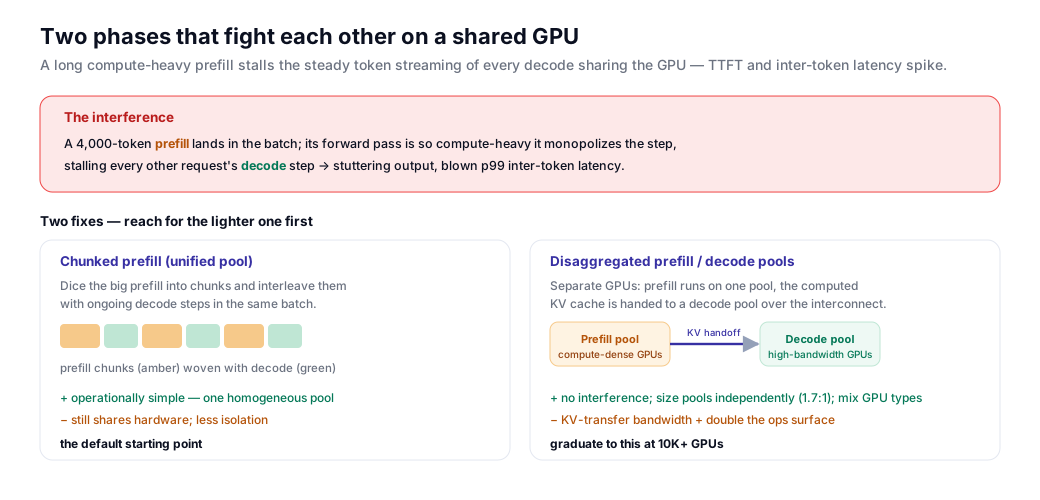 Figure 1. Prefill processes the whole prompt in one compute-bound pass; decode generates tokens one at a time, memory-bandwidth-bound. Run both naively on one GPU and a long prefill stalls everyone's token streaming.
This tension — a chunky prefill monopolizing a step and blowing every other request's inter-token latency — is exactly what a mixed workload produces, and it's what will justify chunked prefill and eventually disaggregated serving later. We park the fix and carry the constraint forward.
3. Scale estimation — requests is the wrong unit
The math runs from users straight to a GPU count and a dollar figure, which is ultimately what the design lives or dies on.
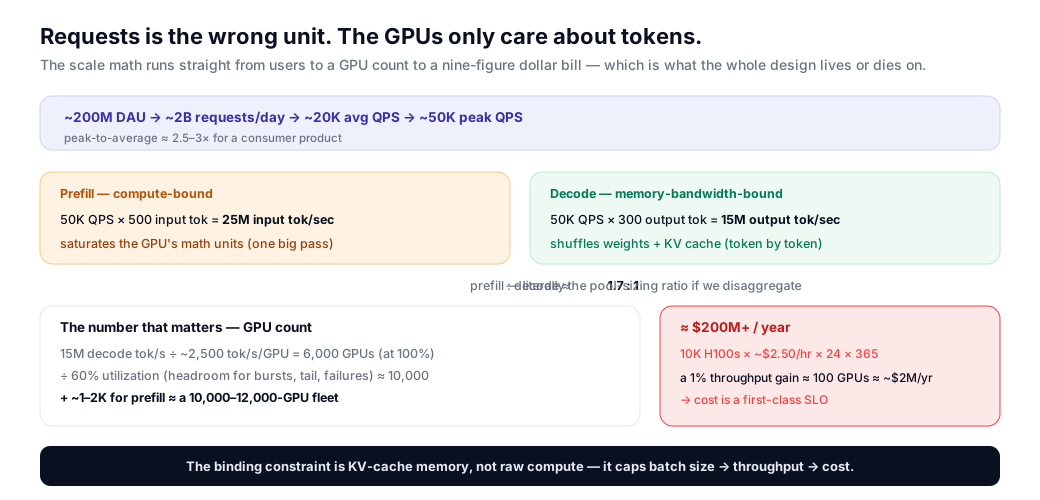 Figure 2. ~200M DAU → ~2B requests/day → ~50K peak QPS. Converted to tokens, that's ~25M input and ~15M output tokens/sec — and the GPUs only care about tokens.
At ~50K peak QPS with a 500-in / 300-out token profile, the platform must serve ~25M
input tokens/sec (prefill, compute-bound) and ~15M output tokens/sec (decode,
memory-bound) — a ~1.7:1 ratio that becomes the pool-sizing ratio if we disaggregate.
Anchoring on a working figure of ~2,500 decode tokens/sec/GPU for a mid-size model on an
H100, decode alone needs 15M ÷ 2,500 = 6,000 GPUs at 100% utilization, or ~10,000 at a
realistic 60%, plus 1–2K for prefill — a 10,000–12,000-GPU fleet costing **$200M+
a year**. At that scale a 1% throughput improvement is ~100 GPUs ≈ ~$2M/year, which is why
batching and disaggregation aren't premature optimization — each is worth eight figures.
Two things are deliberately not the bottleneck. Network egress is trivial (~60 MB/s of actual token payload); the bandwidth that matters is GPU memory bandwidth and the interconnect (NVLink/InfiniBand) carrying tensor-parallel traffic. And the binding constraint on throughput is KV-cache memory, not compute. The one assumption most worth validating is that ~2,500 tokens/sec/GPU figure — everything downstream scales off it, which is precisely what a benchmarking platform measures per model and per hardware type.
4. Architecture — a stateless shell around a scarce GPU core
The shape follows from the estimation: a cheap, infinitely-scalable stateless front end wrapped around a precious, carefully-managed GPU core, with a control plane that manages that core without ever sitting in its critical path.
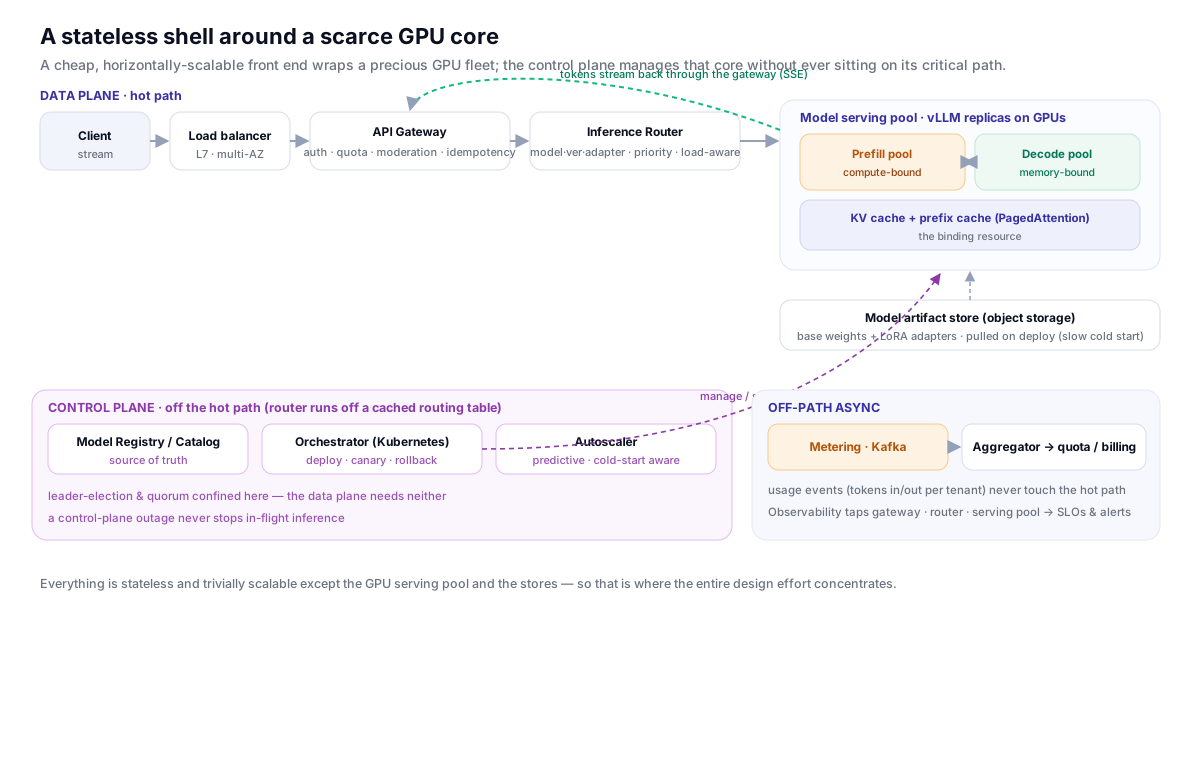 Figure 3. The data-plane hot path (load balancer → gateway → router → serving pool, tokens streaming back) is where latency and GPUs live; the control plane deploys and scales the fleet off the hot path.
A request hits an API Gateway that does the cheap, CPU-bound work — auth, quota, rate limiting, input moderation (reject before a single second of GPU is spent), and idempotency-key checks — none of which touches a GPU, so it scales horizontally and cheaply. The authenticated, clean request reaches the Inference Router, the brain of the data plane: it resolves model + version + adapter + priority and decides which pool and replica should serve it. The router hands off to a Model Serving Pool of vLLM replicas, optionally split into prefill and decode sub-pools, with the KV / prefix cache attached. Tokens stream back out through the gateway (one consistent place for auth, metering, and connection management) over SSE.
The two design decisions worth stating: the control plane is fully off the hot path — if the registry or orchestrator dies, in-flight inference keeps serving because the router runs off a cached routing table (the eventual-but-durable consistency we accepted) — and everything is stateless except the GPU pools and the stores, so the genuinely hard, expensive, stateful thing is the serving pool. That's exactly where the rest of the design effort concentrates.
5. The serving pool — the part that determines good vs bankrupt
Everything outside this box is plumbing you'd find on any system. This is where the LLM-specific engineering lives, and it's best understood by feeling the constraint from the single-GPU problem outward.
The naive design — one request per GPU until done — is catastrophic. Decode is memory-bandwidth-bound, so generating one token barely uses the math units; you're mostly reading weights out of memory. Serve one request at a time and the compute sits ~95% idle while you pay full freight for the memory traffic. The entire art of LLM serving is filling that idle compute by running many requests at once.
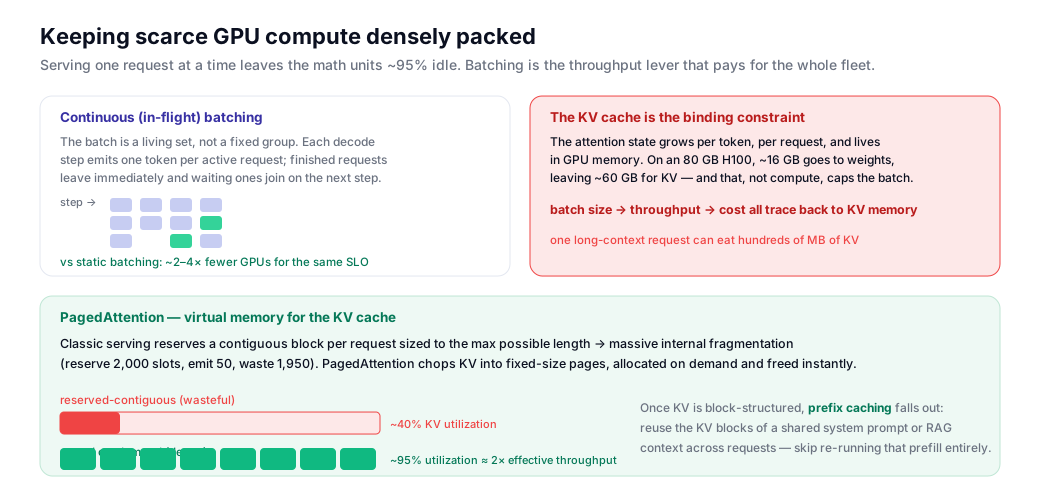 Figure 4. Continuous batching keeps the GPU densely packed despite wildly varying request lengths; the KV cache is the binding resource; PagedAttention pages it like virtual memory to near-eliminate waste.
Continuous (in-flight) batching is the foundation. Instead of a fixed batch where everyone waits for the slowest request, the engine works at the granularity of a single decode step: each step emits one token per active request, finished requests leave immediately, and waiting ones join on the next step. The batch is a living set. This is non-negotiable at scale — a static-batching server needs roughly 2–4× the GPUs for the same SLO.
The binding constraint is the KV cache — the per-token, per-request attention state that lives in GPU memory. On an 80 GB H100 hosting a ~16 GB model, ~60 GB is left for KV, and that, not compute, caps how many requests batch together. PagedAttention earns its keep here: classic serving reserves a contiguous block per request sized to the maximum possible length, wasting most of it; PagedAttention chops KV into fixed-size pages allocated on demand, taking utilization from ~40% to ~95% — roughly 2× effective throughput, which at our fleet size is thousands of GPUs. Once KV is block-structured, prefix caching falls out: reuse the computed KV blocks of a shared system prompt or RAG context across requests and skip that prefill entirely.
The mixed workload forces the big fork from Figure 1. The lighter fix, chunked prefill, dices a long prefill into chunks interleaved with decode steps on one homogeneous pool — the default first reach. The heavier fix, justified at our scale, is disaggregated serving: physically separate prefill and decode GPUs, handing the computed KV cache across the interconnect. Each pool is sized independently (that 1.7:1 ratio), prefill bursts can never stall decode, and — crucially for the next section — you can use different GPU types for each phase. The cost is real: KV-transfer bandwidth and a doubled operational surface. So: chunked prefill on a unified pool first, graduate to disaggregation at 10K+ GPUs.
Two more pieces live here. For models too big for one GPU, tensor parallelism shards each layer across GPUs within a node up to the NVLink boundary; pipeline parallelism spans nodes only when forced. And for the many fine-tuned variants, multi-LoRA serving keeps one base model resident and dynamically applies tiny adapters — even batching different adapters together — collapsing dozens of would-be deployments onto one pool. If there's one bottleneck in this entire box, it's KV-cache memory capacity, full stop.
6. Heterogeneous GPUs — right model, right phase, right hardware
At 10K+ GPUs, treating the fleet as uniform leaves money on the table. The cost lever is matching each workload to the cheapest hardware that still meets its SLO — and disaggregation makes this natural, because prefill and decode want different GPUs.
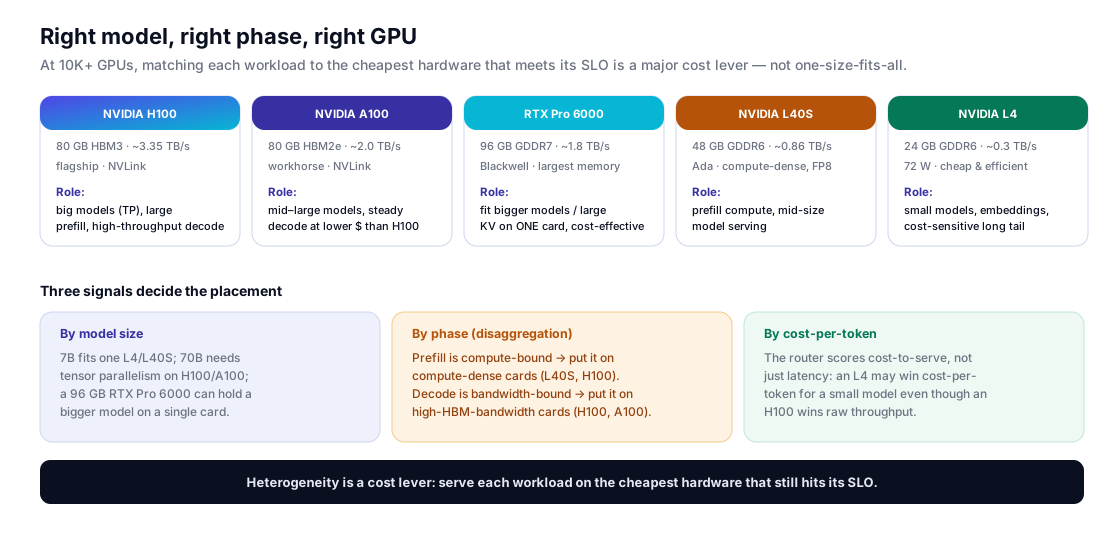 Figure 5. Five GPU classes, three placement signals. Decode is bandwidth-bound and wants high-HBM cards; prefill is compute-bound and wants compute-dense cards; small models and embeddings want cheap, efficient cards.
The fleet spans, roughly: the H100 (80 GB HBM3, ~3.35 TB/s) for big tensor-parallel models, large prefill, and high-throughput decode; the A100 (80 GB HBM2e, ~2 TB/s) as the workhorse for mid-to-large models and steady decode at lower cost; the RTX Pro 6000 (96 GB GDDR7, Blackwell) whose large single-card memory fits a bigger model — or a larger KV budget — on one device cost-effectively; the L40S (48 GB, compute-dense Ada with strong FP8) for prefill compute and mid-size models; and the L4 (24 GB, ~72 W, cheap and efficient) for small models, embeddings, and the cost-sensitive long tail.
Three signals decide placement. By model size: a 7B fits one L4 or L40S, a 70B needs tensor parallelism on H100/A100, and a 96 GB RTX Pro 6000 can hold a bigger model on a single card. By phase: route compute-bound prefill to compute-dense cards (L40S, H100) and bandwidth-bound decode to high-HBM-bandwidth cards (H100, A100) — disaggregation made physical. By cost-per-token: the router scores cost-to-serve, not just latency, so an L4 can win cost-per-token for a small model even where an H100 wins raw throughput. The principle is simple and worth millions: serve each workload on the cheapest hardware that still hits its SLO.
7. The router, scheduling, and graceful saturation
The router can't be a normal load balancer, because neither of a load balancer's assumptions holds: our requests vary ~100× in cost (a 10-token reply vs a 4,000-token generation), and our replicas aren't interchangeable — each has different KV headroom, queue depth, and a different set of adapters and prefixes already hot.
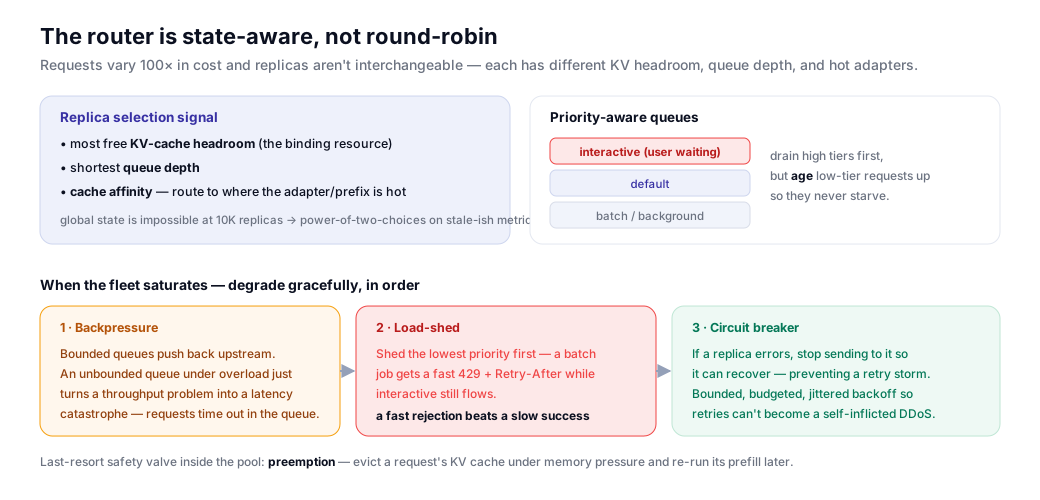 Figure 6. The router selects on KV headroom + queue depth + cache affinity, runs priority-aware queues with aging, and degrades through backpressure → load-shedding → circuit breakers.
Replica selection routes on a composite signal — most free KV-cache headroom (the binding resource), shortest queue, and a cache-affinity bonus toward replicas that already have this request's adapter or prefix resident. Perfect global state is impossible at 10K replicas, so the router uses slightly-stale heartbeated metrics and power-of-two-choices sampling. Priority scheduling runs a few tiers (interactive, default, batch) drained high-first, but with aging so sustained interactive load can't starve batch forever.
When the fleet saturates — which it will, because GPUs can't scale in seconds — the router degrades in order: backpressure via bounded queues (an unbounded queue under overload just converts a throughput problem into a latency catastrophe), then load-shedding that drops the lowest priority first with a fast 429 + Retry-After (a fast rejection beats a slow success), then circuit breakers on failing replicas with bounded, budgeted, jittered backoff so retries can't become a self-inflicted DDoS. Inside the pool, preemption — evict a request's KV cache and re-run its prefill later — is the last-resort safety valve that prevents out-of-memory crashes, since generation length is unknown at admission time.
8. Autoscaling and capacity planning
This is where an inference platform diverges most sharply from a normal web service: cold start is minutes, not seconds — schedule onto a GPU node, pull multi-GB weights, load, warm up. By the time a reactively-scaled GPU is ready, the spike is over. So the design attacks it from several angles. Scale on the right signal — queue depth, KV utilization, and tokens/sec headroom, never CPU. Scale predictively — inference traffic follows a diurnal curve, so pre-warm against a forecast and use reactive scaling only for the residual. Keep a warm buffer of idle replicas as a shock absorber (an explicit cost-versus-resilience dial). Cut the cold start with node-local weight caches and LoRA-only swaps. And scale down lazily with hysteresis — scale up eagerly, down slowly — to avoid paying the cold-start cost repeatedly. Stepping up, capacity is a planning problem first and an autoscaling problem second: at 10K+ GPUs with multi-month procurement lead times, you forecast token demand on a quarterly horizon and reserve fleet ahead of need; autoscaling only handles the daily wiggle within capacity you've already secured.
9. API, caching, reliability
The API is REST + Server-Sent Events externally (the de-facto LLM shape, streams over
plain HTTP) and gRPC internally; a POST /v1/generate carries model/version/adapter,
generation controls, a priority tier, and an Idempotency-Key, and returns a first-class
usage block (so metering and the caller agree on token counts) and a finish_reason.
Rate limiting is token-based, not request-based — one request can be 100× another's cost,
so requests-per-minute is meaningless; the real limit is tokens-per-minute, surfaced via
X-RateLimit headers with 429 + Retry-After on breach. Idempotency keys (held in Redis with
a 24 h TTL and a pending state for in-flight retries) make our at-least-once + idempotent
dedup = effectively-once semantic real.
Caching is two different animals. GPU-resident caching (KV per request, prefix cache) is the expensive, LLM-specific layer; the prefix cache is immutable — the same tokens through the same model version always produce the same KV state — so it has no invalidation hazard, only weighted-LRU eviction, and it competes directly with live KV for memory. Conventional Redis caching serves idempotency (correctness), the routing-table cache (the data plane's independence from the control plane), and atomic quota counters. Stampede prevention uses single-flight coalescing (one request prefills a hot shared prefix while the rest reuse it, not 500 redundant prefills), jittered TTLs, probabilistic early expiration, and serve-stale-while-revalidate — plus staggered weight pulls so a scale-up doesn't herd the artifact store.
Reliability spends its budget asymmetrically. The stateless tier is N+2 multi-AZ (provisioned for N-1 survival) and trivially recoverable. The GPU tier is the hard part, because a replica holds non-replicable in-flight KV state — when it dies, those generations are gone. The defenses: continuous batching bounds the blast radius (one replica is hundreds of requests, not millions); idempotent retry recovers lost requests on a healthy replica (the idempotency key is also our internal failure-recovery mechanism); "replication" means replicating capacity (≥2 AZ-spread replicas per model), not data; and the warm buffer does double duty as a failure absorber against the brutal cold-start recovery time. The control plane is deliberately not a SPOF for serving, and all the leader-election/quorum machinery is confined to it. Multi-region is the four-nines step we defer because it roughly doubles the GPU bill. The honest framing: you don't buy GPU reliability with protocols — you buy it with spare GPUs.
10. Observability, security, and async
Observability has a third question no CRUD service has: not just "is it up and fast?" but "is it still good?" A model can be perfectly available and fast while silently producing worse output. So three layers: infra metrics; inference-performance metrics (TTFT, ITL, GPU/KV utilization, queue depth, tokens/sec/GPU — where KV utilization and queue depth are leading indicators that double as the autoscaler's control signals); and the hard quality layer. Phase-level tracing (queue → moderation → prefill → decode → network) is what makes latency debuggable — the same total TTFT means something different if it's queue wait (scale up) vs a long prefill (chunked prefill) vs over-large decode batches (back off). Silent degradation is caught with cheap always-on proxies (output-length distribution, finish_reason mix, refusal and guardrail-trip rates), online signals (thumbs, regeneration rate), and shadow/canary evaluation that gates rollouts — the benchmarking framework doing production duty.
Security here is woven through the data path because every request can carry sensitive content. Stateless JWT/OAuth + API-key auth at the gateway (short TTLs to manage the revocation tradeoff); per-tenant authz over models, adapters, and priority tiers; and the critical isolation detail — caches must be tenant-keyed, because a shared-prefix cache hit across tenants would leak one tenant's context into another's. PII handling rests on retention minimization, metadata-first logging (never log raw prompts/completions by default), data residency, and a no-training-without-consent policy. And the LLM-specific abuse vector isn't volume — it's a few maximally expensive requests (max context, max output), so limiting must be token-cost-aware with per-request cost caps and per-tenant cost circuit-breakers.
Async messaging keeps the hot path synchronous and shoves everything off-path onto a queue. Metering rides Kafka, partitioned by tenant (ordered per-tenant aggregation; watch hot partitions for whale tenants), with at-least-once + idempotent consumer dedup = effectively-once billing, consumer lag as the pipeline SLI, and a dead-letter queue so a poison event can't wedge a partition. Batch inference rides a low-priority queue to backfill the diurnal troughs — a direct utilization win.
11. Evolution — MVP → 10× → 100×
The architecture described is the mature version; you would not build all of it on day one.
At MVP, strip to essentials: a stateless gateway, a simple router, and a single unified GPU pool running vLLM with continuous batching and PagedAttention (not optional even at MVP — they're the difference between viable and bankrupt unit economics), chunked prefill, ≥2 replicas per model, idempotency, and input moderation. Metering can start as plain logging before Kafka. The MVP is complete as a product — just not yet efficient or huge.
At 10×, traffic and cost are real, so you spend engineering to claw back GPU: disaggregated prefill/decode, prefix caching with coalescing, multi-LoRA to collapse the proliferating fine-tunes, load-aware cache-affinity routing, predictive autoscaling with a warm buffer, Kafka metering, phase-level tracing, and the first eval gating on rollouts. Same architecture, now squeezed for utilization.
At 100×, the serving is solved and the hard problems migrate: capacity planning on a quarterly horizon becomes central, multi-region becomes real (availability and data residency), heterogeneous-hardware routing across the GPU classes in Figure 5 becomes a serious cost lever, and the router itself may go hierarchical/regional. The architecture's shape barely changes across three orders of magnitude — a stateless shell around a managed GPU core with an off-path control plane — which is the sign the foundational decomposition was right.
12. Key takeaways
- Everything is the throughput–latency–cost triangle, and the triangle is one scarce resource — GPU memory and GPU time. You buy performance and reliability with spare silicon, which makes the cost dial unusually direct.
- KV-cache memory is the binding constraint — it caps batch size, throughput, and cost. Continuous batching plus PagedAttention (roughly 2× effective throughput) are how you stop wasting it.
- Requests is the wrong unit; tokens is the right one — and prefill (compute-bound) and decode (memory-bound) are different enough to justify disaggregation at scale.
- Heterogeneous GPUs are a cost lever — match model size, phase, and cost-per-token to the cheapest hardware that hits the SLO, from L4s for small models to H100s for big tensor-parallel ones.
- Cold start is minutes, so reliability and burst-headroom are bought with pre-warmed idle GPUs, and capacity is a quarterly planning problem before it's an autoscaling one.
13. Open questions
- What is the real, benchmarked tokens/sec/GPU per model and per hardware class — the number the entire fleet sizing rests on, and the thing most worth measuring before trusting any cost estimate?
- Where exactly does disaggregation start to pay — at what fleet size and KV-transfer cost does the interference win beat the operational complexity?
- How much can a cost-aware, heterogeneous-hardware router save in practice once it scores cost-to-serve across five GPU classes rather than routing on load alone?
- What's the most reliable way to catch silent quality regression from an upstream model change before it reaches everyone — the failure mode no infra metric will ever flag?
References
- W. Kwon et al., Efficient Memory Management for Large Language Model Serving with PagedAttention (vLLM), SOSP 2023 (arXiv:2309.06180).
- T. Dao et al., FlashAttention: Fast and Memory-Efficient Exact Attention with IO-Awareness, NeurIPS 2022 (arXiv:2205.14135).
- G.-I. Yu et al., Orca: A Distributed Serving System for Transformer-Based Generative Models (continuous batching), OSDI 2022.
- P. Patel et al., Splitwise: Efficient Generative LLM Inference Using Phase Splitting (prefill/decode disaggregation), ISCA 2024 (arXiv:2311.18677).
- A. Agrawal et al., Taming Throughput-Latency Tradeoff in LLM Inference with Sarathi-Serve (chunked prefill), OSDI 2024 (arXiv:2403.02310).
- E. J. Hu et al., LoRA: Low-Rank Adaptation of Large Language Models, ICLR 2022 (arXiv:2106.09685).
- Y. Sheng et al., S-LoRA: Serving Thousands of Concurrent LoRA Adapters, 2023 (arXiv:2311.03285).
- A. Verma et al., Large-scale Cluster Management at Google with Borg, EuroSys 2015.
- A. Vattani, F. Chierichetti, K. Lowenstein, Optimal Probabilistic Cache Stampede Prevention, VLDB 2015.
- M. Mitzenmacher, The Power of Two Choices in Randomized Load Balancing, IEEE TPDS 2001.
- NVIDIA documentation — H100, A100, L40S, L4, and RTX Pro 6000 datasheets; NCCL; Multi-Instance GPU (MIG); Triton Inference Server; and the Kubernetes GPU device plugin.
Final entry in an ongoing architecture-study series. The companion pieces made one model fast (kernel fusion), scaled many across a fabric (MoE networking), built everything around the model (per-user RAG), and measured them all (benchmarking). This one is the platform that actually runs them — where, at ten thousand GPUs and a nine-figure bill, almost every decision is the same dial: how much do you pay, in money or complexity, to protect latency?