← Architecture Studies5. The reframing —
AI Infrastructure
Per-User RAG at Scale: Architecting a Private AI Inbox for 220M Users and Billions of Queries a Day
Xariv Infrastructure··32 min
Architecture Study. This is a hypothetical system study. The scale figures, SLAs, and design choices are illustrative and do not describe any specific employer or production system. The aim is to reason from first principles about a class of problem — large-scale, per-user, privacy-isolated retrieval — that recurs across consumer AI assistants.
1. Executive summary
We studied a hypothetical AI inbox: a consumer mail assistant where a user asks "summarize my travel receipts from last month" and gets a grounded, cited answer drawn from their own email, messages, and files. This is per-user, private RAG (Retrieval-Augmented Generation) at the scale of 220M users and ~2 billion queries per day, where generation itself is a hosted LLM API call, so the design is everything around that call: ingestion, indexing, retrieval, ranking, orchestration, grounding, and the isolation and compliance machinery.
Three findings reframe the whole system. First, despite "RAG" sounding read-heavy,
mail arrives constantly, so the system is write-dominated — ~310K embedding
writes/sec against ~23K average query QPS. Second, the hosted-LLM token bill
(~$500M/year) dwarfs every other line item, which makes not calling the LLM the
organizing principle of the read path. Third — and this is the spine of the design —
because retrieval is always scoped to a single user, partitioning by user_id
collapses an impossible global-search problem into a trivial per-user one, and
simultaneously delivers isolation, cost-tiering, and compliance-grade deletion. This
is the walkthrough.
2. Business context
The shape of the problem comes from a handful of locked-in requirements: per-user private corpora (emails, messages, files); two freshness tiers (a nightly bulk re-index plus near-real-time indexing of newly arrived content in seconds-to-minutes); multimodal inputs (PDFs needing OCR, tables, images); a hosted LLM; low hallucination tolerance with mandatory citations; per-user isolation; hard cost discipline; and a full compliance envelope (encryption, PII handling, data residency, audit logging).
One tension runs through everything: per-user isolation, near-real-time freshness, and cost optimization pull against each other. Per-user indexes mean 220M tiny corpora rather than one shared one; real-time freshness means a constant write stream; cost optimization means avoiding both excess infrastructure and excess LLM calls. Reconciling those three is the heart of the design.
3. Scale estimation — where intuition flips
Numbers first, because they change what kind of system this is.
With ~110M daily-active users and ~2B queries/day, average load is 2,000,000,000 ÷ 86,400 ≈ ~23K QPS, peaking around ~70K. That feels read-heavy until you size the write path. If 220M users each receive ~40 emails/day (plus messages and files), that's ~9B documents/day; at ~3 chunks each, ~27B chunks/day, or ~310K embedding writes/sec — an order of magnitude heavier than the read path.
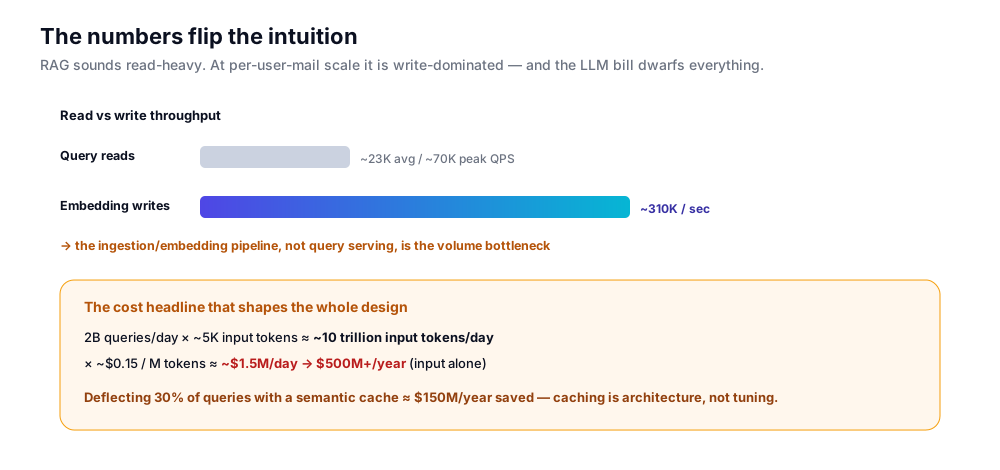 Figure 1. The intuition flip: the ingestion/embedding pipeline, not query serving, is the volume bottleneck — and the hosted-LLM bill dominates the economics.
Storage compounds it. At ~10K embedded chunks per user, that's 220M × 10K ≈ 2.2 trillion vectors. A 768-dim fp32 vector is ~3KB; int8 quantization cuts it to ~768 bytes, taking the corpus from ~6.6 PB to ~1.7 PB — which is why quantization is load-bearing, not optional. Add raw chunk text and metadata for citations and you land at multi-petabyte scale.
Then the headline. Each query ships ~10 retrieved chunks (~5K input tokens) to the
hosted LLM: 2B × 5K ≈ 10 trillion input tokens/day. Even at ~$0.15 per million
tokens that's $1.5M/day, **$500M+/year on input tokens alone**. That single number
is why caching and query-deflection aren't optimizations — they're architecture.
Deflecting even 30% of queries is ~$150M/year.
So the three pressures carried forward: write-heavy ingestion, petabyte per-user partitioning, and deflect-the-LLM cost discipline.
4. Architecture overview — two systems sharing a storage layer
The cleanest framing is that this is two systems with a shared substrate: a write/ingestion path running constantly in the background, and a read/query path that fires when a user asks something. Because the system is write-dominated, the architecture must make those paths independent, so the ingestion firehose can never starve query latency.
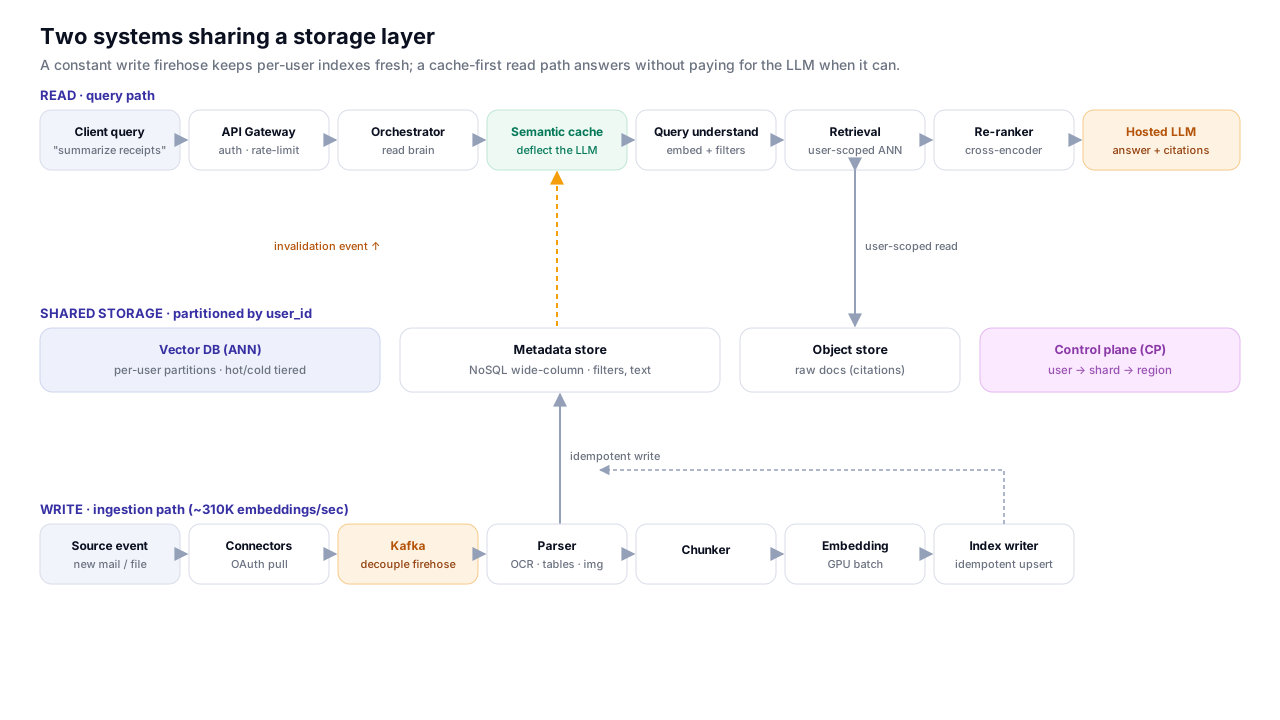 Figure 2. A Kafka-decoupled write path keeps per-user indexes fresh; a cache-first read path does everything possible to answer without an LLM call. Both share a user-partitioned vector store and metadata store, governed by a small consistent control plane.
On the read path, a request hits the API gateway (TLS, JWT auth, and per-user rate limiting that doubles as budget protection), then an orchestrator that checks the semantic answer cache first (deflect if hit), embeds the query and extracts filters ("last month" → a timestamp range), retrieves user-scoped candidates, re-ranks them with a cross-encoder, assembles a grounded prompt, calls the hosted LLM, and streams back an answer with citations.
On the write path, source events flow through OAuth-scoped connectors into Kafka, then parser/OCR workers, a chunker, a batched GPU embedding service, and an index writer that performs idempotent upserts and emits a cache-invalidation event. Kafka is load-bearing: it decouples "an email arrived" from "it got embedded and indexed," absorbs bursts, enables replay, and lets the two freshness tiers ride separate topics so a nightly bulk re-index never delays fresh mail.
The one-line story: decoupling protects latency from the write firehose, cache-first protects the budget, and user-scoped partitioning protects isolation.
5. The reframing — user_id as the universal partition key
Here is the insight that makes the rest tractable.
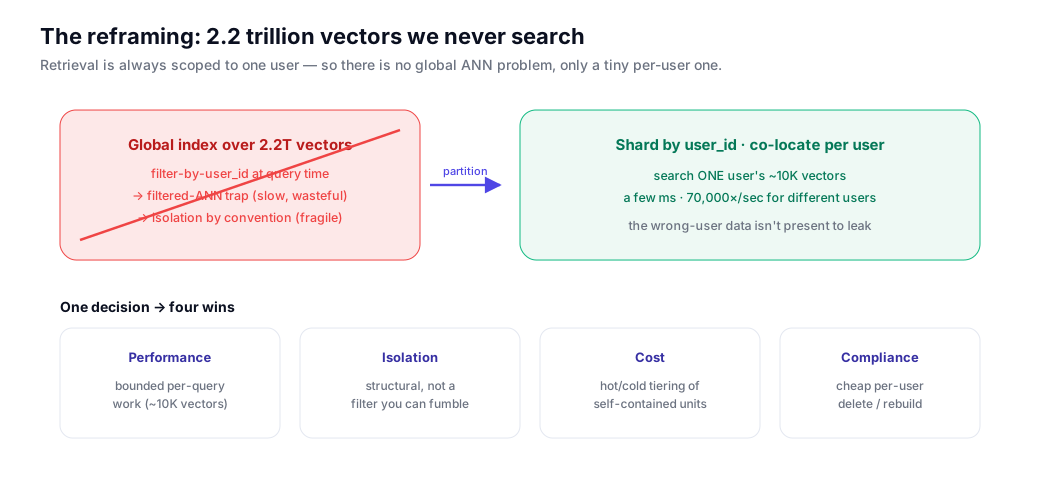 Figure 3. We never search 2.2 trillion vectors. Because retrieval is always scoped to one user, the real problem is ANN over one user's ~10K vectors — done 70,000 times a second for different users.
2.2 trillion vectors is a frightening number we never actually search, because there is no cross-user query — ever. So the question isn't "how do I run approximate nearest neighbor (ANN) over 2.2T vectors," it's "how do I run ANN over one user's ~10K vectors, 70K times a second." Searching 10K vectors is trivial.
Both extremes are traps. One ANN index per user (220M tiny HNSW graphs) dies on
fixed per-index overhead and lifecycle management. One global index filtered by
user_id is the classic filtered-ANN trap — the graph walk keeps surfacing other
users' vectors you discard, and isolation-by-filter is fragile. The answer is in the
middle: shard by user_id, co-locate per user, search only within the user's
segment. That single decision is simultaneously the performance story, the isolation
story, the cost story, and the compliance story.
6. Storage — polyglot persistence, tiering, and the CAP split
This isn't one database; it's four, each matched to an access pattern. Vectors go in a
specialized ANN index. Chunk metadata (text, source, timestamp, doc_id, user_id)
goes in a NoSQL wide-column store (Bigtable/Cassandra/DynamoDB-style), because the
access pattern is a single-partition scan keyed by user_id — write-dominated,
petabyte-scale, with no cross-user joins, exactly what SQL's transactions and joins
don't help. Raw documents go in object storage, fetched only for citation
display. And one small SQL/consistent control plane holds the
user → shard → region mapping, where strong consistency is cheap and essential.
Sharding uses consistent hashing on user_id across a few thousand shards (each
holding millions of users), with virtual nodes for even distribution. Consistent
hashing matters because the corpus only grows: adding a shard remaps ~1/N of users
instead of reshuffling petabytes. Per-user skew (a decade-long power user with millions
of chunks) averages out with millions of users per shard.
Tiering is the core cost lever, and it's only possible because each user's index is a self-contained unit.
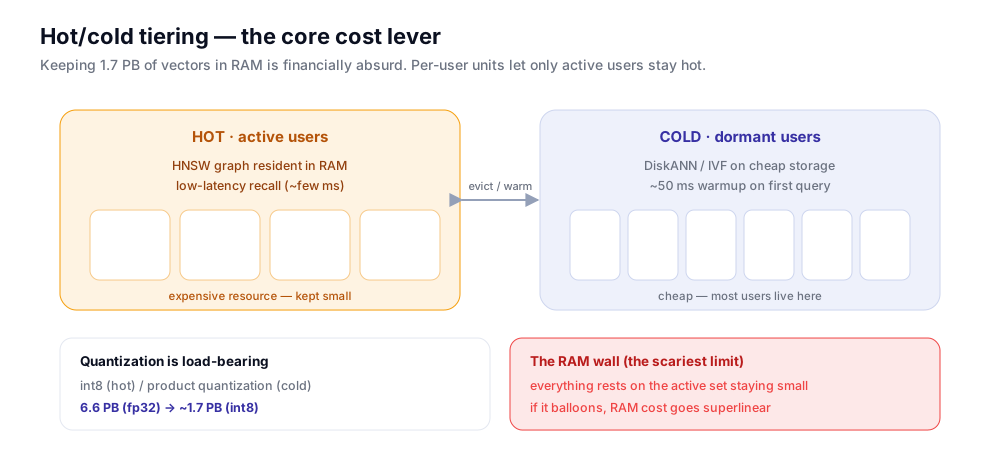 Figure 4. Active users' HNSW graphs stay hot in RAM; dormant users tier down to DiskANN/IVF on cheap storage with a small warmup cost. Keeping all 1.7 PB hot would mean renting petabytes of RAM — the binding constraint of the whole system.
Deletes fall out naturally too: HNSW doesn't truly delete (it tombstones and degrades), but rebuilding one user's tiny index to compact tombstones is cheap and routine — so right-to-be-forgotten is structurally affordable, where compacting a global trillion-vector index would be a nightmare.
On CAP, the split is deliberate: the data plane (vectors + metadata) is AP —
under a partition I serve slightly stale results rather than fail, which is in spec
because we already promised seconds-to-minutes freshness. The control plane is
CP — routing a user to the wrong shard could leak another user's data, so it's
never traded, but it's tiny and stable. A nice property falls out: because everything
routes by user_id, a user's reads and writes hit the same primary, giving
read-your-own-writes ("I just got an email, summarize it" works) even under global
eventual consistency.
On the vector engine itself, the honest answer is measure, don't guess. A managed service like Pinecone is the right call at startup scale (namespaces map cleanly to tenants) but its margin and its handling of hundreds of millions of tiny tenants strain at this scale; OpenSearch gives native hybrid (vector + BM25 + filters) and self-hosting control at real operational cost; and a tiered Vespa or custom FAISS/DiskANN service is the likely end state — decided by benchmarking recall, latency, and cost against real numbers.
7. The read path and its latency budget
Putting a budget on the read path reveals which optimizations actually matter:
| Stage | Approx. latency |
|---|---|
| Gateway auth + rate-limit (local JWT verify) | ~5 ms |
| Semantic cache lookup | ~10 ms |
| Query embedding | ~30–50 ms |
| Retrieval (hot user index) | ~10 ms (+~50 ms cold warmup) |
| Re-ranking (cross-encoder over ~50 candidates) | ~40–60 ms |
| Prompt assembly | ~5 ms |
| Hosted LLM to first token | ~500 ms–1 s+ |
The lesson to say out loud: the LLM call is ~70% of the budget and we don't control
it. Shaving retrieval from 10 ms to 5 ms is theater. The only levers that matter are
(a) hitting the cache to skip the LLM entirely, and (b) streaming tokens the
instant the LLM emits them. So the external query API is a POST that opens an
SSE (Server-Sent Events) stream — unidirectional, rides plain HTTP through the CDN,
auto-reconnects — and it sends citations first, before generation, so sources
render instantly and grounding is visible:
event: sources
data: {"citations":[{"doc_id":"mail_8842","title":"Receipt — United","date":"2026-05-12"}]}
event: token
data: {"delta":"You spent $1,240 across 3 trips "}
event: done
data: {"request_id":"req_77a1","cache":"miss"}
Internally, services talk gRPC (compact protobuf over HTTP/2) at 70K QPS, and
user_id is a required field on the retrieval contract — isolation living in the
type system, not a comment.
8. Caching — the cost engine, and why invalidation is the hard part
The semantic answer cache is simultaneously the biggest cost lever and the biggest
correctness risk: every other cache returns exactly what you asked for; this one
returns an answer to a similar question. Lookup is therefore vector similarity,
not exact match — which means the answer cache is itself a tiny per-user RAG, sharded
by user_id, inheriting every isolation requirement. The governing knob is the
similarity threshold: loosen it and hit-rate (and savings) climb but you risk
serving a confidently-wrong cached answer; given low hallucination tolerance, bias
tight and treat it as something tuned against a quality eval, not guessed.
Invalidation is where naive caching breaks. A pure TTL short enough to honor a seconds-to-minutes freshness SLA collapses the hit-rate to nothing, so we use the event-driven loop the architecture already wired in — but with the right granularity.
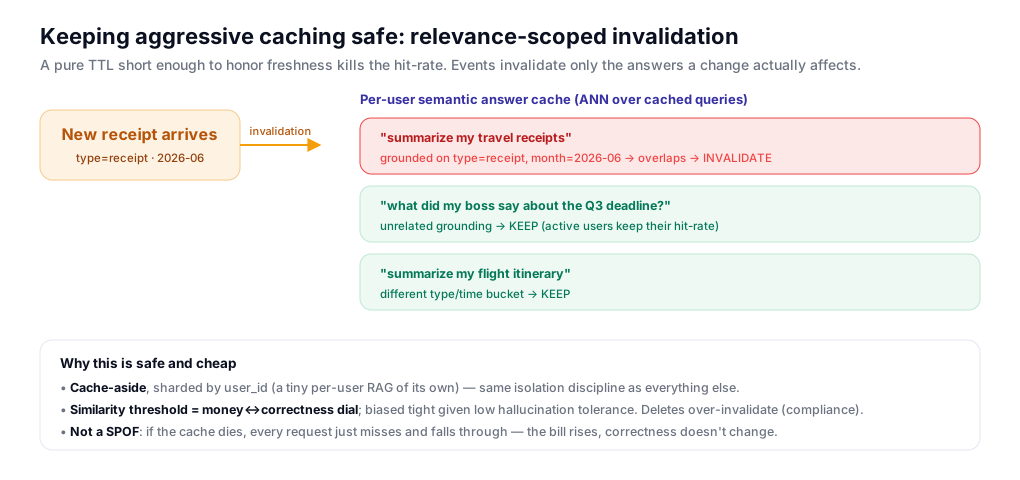 Figure 5. Flushing all of a user's cache on any change punishes exactly the active users who query most. Instead, a change invalidates only cached answers whose grounding overlaps it (by document type and time bucket), keeping unrelated answers alive.
Each cached answer is tagged with what it was grounded on; a new receipt invalidates receipt-summaries but leaves "what did my boss say about the Q3 deadline" untouched. Deletes deliberately over-invalidate — surfacing legally-deleted content is worse than a cache miss. A TTL with jitter stays as a backstop for anything the event system misses. And critically, the cache is not a SPOF: if Redis dies, every request simply misses and falls through to the real pipeline — the bill rises and latency grows, but correctness and availability don't change. That property is what licenses running it aggressively.
9. Ingestion and messaging — Kafka, ordering, and idempotency
The single most important decision in the messaging layer is ordering, because getting it wrong produces silent corruption no amount of replication fixes.
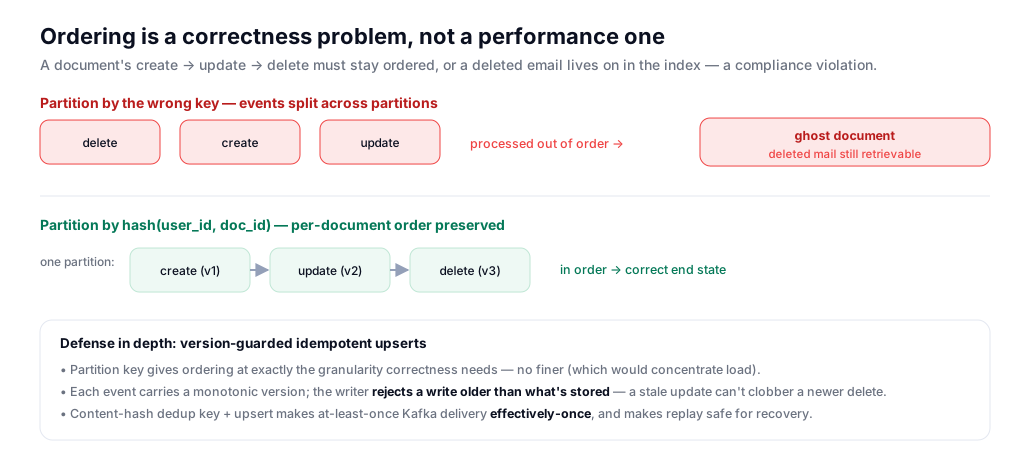 Figure 6. A document's create → update → delete must stay ordered. Split across partitions, a delete can be processed before the create, leaving a "ghost" — a deleted email still retrievable, which is a compliance violation, not a cosmetic bug.
Kafka only guarantees order within a partition, so the partition key must keep a single
document's events together. Partitioning by user_id over-orders (and concentrates a
heavy user's load on one partition); partitioning by hash(user_id, doc_id) gives
ordering at exactly the granularity correctness needs — per document — while spreading
load. As a backstop, every event carries a monotonic version, and the writer
rejects a write older than what's stored, so even a redelivered, out-of-order
update can't clobber a newer delete.
This composes with the idempotency story. Kafka is at-least-once, so duplicates happen;
rather than chase expensive exactly-once delivery, each document carries a
deterministic dedup key — hash(user_id, source_message_id) — and the writer
upserts on it. Reprocessing is a no-op. That one decision yields three properties:
dedup, safe retries, and safe replay — rewinding a Kafka offset to rebuild a
corrupted index reproduces the identical end state. Topics are split by freshness tier
(real-time vs nightly bulk, separate consumer groups) and by stage, and poison messages
are quarantined to a dead-letter queue after bounded retries so one bad scanned PDF
can't head-of-line-block a partition.
10. Failure modes worth designing for
Four failure modes dominate. Cache stampede — many identical queries missing at once (e.g., an 8am "summarize my day") — is defended with request coalescing (single-flight), probabilistic early expiration, and jittered TTLs, plus a circuit breaker as backstop. Hot users / noisy neighbors — the partition key that minimizes isolation blast-radius concentrates load blast-radius on one shard — is handled by the per-user rate limiter, promoting whales to dedicated resources, and per-shard load shedding (batch before interactive). Consumer lag on the ingestion firehose is the SLA killer; the bottleneck is the embedding GPU step, so we batch aggressively (with a max-batch-timeout), autoscale on lag, not CPU, and isolate tiers by topic. Retry storms against the hosted LLM are tamed with exponential backoff + jitter, a retry budget (caps aggregate retries, not just spacing), and a circuit breaker that fails fast to let the upstream recover.
11. Security — isolation enforced, not assumed
The catastrophic failure here isn't downtime; it's one user seeing another's mail. So
isolation is enforced in four independent layers, defense in depth, so no single
bug leaks data: (1) at the edge, the authoritative user_id comes from the signed
JWT, never a request parameter (killing IDOR); (2) in service contracts, user_id
is a required gRPC field — "retrieve globally" is unrepresentable; (3) in the data
layer, physical per-user partitions mean another user's data isn't present to leak
— isolation is structural, not a WHERE clause; (4) in the cache, keys are
namespaced per user.
Beyond isolation: connectors authenticate to mail providers via OAuth with least-privilege scopes, and those refresh tokens live in a KMS-backed vault (a leaked one is standing access to a real mailbox). Encryption is TLS in transit (including mTLS internally — zero trust, not "the VPC is safe") and at rest with per-region KMS keys that reinforce residency; per-tenant keys enable crypto-shredding — destroy the key to render a user's data unrecoverable instantly, a clean right-to-be-forgotten primitive. The uncomfortable, honestly-named risk is PII egress to the hosted LLM on every query: it demands a zero-retention provider tier, and if compliance tightened, that single concern could force self-hosting — the most contingent assumption in the design. Audit logging (who-queried-what, append-only, tamper-evident, residency-respecting) rides its own pipeline so it never becomes a latency tax.
12. Observability — the hard part is semantic, not mechanical
This system can be perfectly healthy by every mechanical metric — fast, 200s, low CPU — and still be confidently hallucinating. The failure modes that matter most are semantic and invisible to a standard dashboard.
The mechanical layer is table stakes: percentile latency decomposed by stage (to confirm the LLM really is ~70%), and on ingestion, time-to-searchable (measured end to end, not inferred from queue depth) as the freshness SLI. Two metrics are first-class for this system: cache hit-rate (a 5-point drop is millions of dollars, so it's paged like an outage) and LLM cost-per-query (a budget burn-rate alert when spend tracks over forecast). Async tracing across the multi-hop, minutes-long Kafka pipeline uses a correlation ID in the event envelope, not classic request-trace propagation — answering "the email from 10 minutes ago isn't searchable; where is it stuck?" Logs deliberately exclude PII payloads (IDs and metadata only).
Detecting quality regression needs an explicit semantic layer: cheap proxy signals on all traffic (retrieval similarity distribution, "no good results" rate, citation coverage), sampled deep evaluation (LLM-as-judge for groundedness, biased toward risky segments, with human review), and guardrail-trip rate as a real-time signal. The discipline that makes it actionable is canary/shadow evaluation at deploy boundaries — including catching the genuinely scary case where the hosted model silently changes underneath you. The honest limit: quality observability here is statistical and proxied, not a per-query certainty, because exact semantic checking at billions of queries isn't affordable.
13. Evolution — most of this is overkill on day one
The art is knowing which decisions to make early because they're expensive to retrofit, and which to defer.
At MVP (thousands of users, proving the product is useful), collapse almost everything: a single managed vector DB (this is exactly where Pinecone's per-namespace isolation shines), synchronous-ish ingestion, an exact-match cache, single region, direct LLM calls. The two things to get right from day one are the data-model invariants — per-user partitioning and the idempotent write key — because retrofitting isolation onto a shared index, or idempotency after corrupting data, is a rewrite.
At 10x, the managed abstractions crack on cost first: introduce hot/cold tiering (the RAM math now hurts), the semantic answer cache (the LLM bill now justifies the invalidation machinery), real Kafka with two freshness tiers (lag is now a real SLA risk), and split the stateless services.
At 100x (the 220M-user target), move to the self-managed tiered vector store (managed margin is unaffordable at trillions of vectors), make multi-region residency routing mandatory, and activate the full reliability and compliance apparatus — quorum, consensus-backed leader election, in-jurisdiction DR, per-tenant keys, the immutable audit pipeline, and continuous groundedness evaluation. The throughline: each deferred decision activates when its pain crosses the complexity threshold — cost pressures first, scale next, compliance-and-reliability last — and the data-model invariant is the one thing held constant throughout.
14. Key takeaways
- It's write-dominated, not read-heavy — the embedding pipeline (~310K writes/sec) is the volume bottleneck, and the embedding GPU fleet grows with ingestion regardless of query value.
- The hosted-LLM bill (~$500M/yr) dominates everything — so the read path is built to not call the LLM, and cache hit-rate is the load-bearing business metric.
- Partition by
user_idturns an impossible global-ANN problem into a trivial per-user one, and delivers isolation, cost-tiering, and cheap compliance deletes in the same stroke. - The hot-tier RAM wall is the scariest scaling limit — everything rests on the active working set staying small; quantization and tiering are load-bearing.
- Reliability falls out of structure — stateless services, idempotent writes, and a non-SPOF cache mean much of the fault tolerance was bought by decisions made for other reasons; at-least-once + idempotent upserts beats chasing exactly-once.
15. Open questions
- What is the real, empirical cache hit-rate and false-hit-rate, against a quality eval — the number every cost estimate hangs off?
- How large does the hot working set actually get under feature changes that drive more simultaneous activity — and when does the RAM wall bind?
- Can lazy/deferred embedding for low-signal content meaningfully cut the ingestion GPU bill without hurting perceived freshness?
- Could a credible self-hosted model flip the most contingent assumption, trading the $500M token bill and PII-egress risk for GPU-serving complexity?
References
- P. Lewis et al., Retrieval-Augmented Generation for Knowledge-Intensive NLP Tasks, NeurIPS 2020 (arXiv:2005.11401).
- V. Karpukhin et al., Dense Passage Retrieval for Open-Domain Question Answering, EMNLP 2020 (arXiv:2004.04906).
- Y. Malkov, D. Yashunin, Efficient and Robust Approximate Nearest Neighbor Search Using Hierarchical Navigable Small World Graphs (HNSW), 2016 (arXiv:1603.09320).
- S. Subramanya et al., DiskANN: Fast Accurate Billion-point Nearest Neighbor Search on a Single Node, NeurIPS 2019.
- J. Johnson, M. Douze, H. Jégou, Billion-scale Similarity Search with GPUs (FAISS), 2017 (arXiv:1702.08734).
- H. Jégou, M. Douze, C. Schmid, Product Quantization for Nearest Neighbor Search, IEEE TPAMI, 2011.
- R. Guo et al., Accelerating Large-Scale Inference with Anisotropic Vector Quantization (ScaNN), ICML 2020 (arXiv:1908.10396).
- G. DeCandia et al., Dynamo: Amazon's Highly Available Key-value Store, SOSP 2007.
- D. Karger et al., Consistent Hashing and Random Trees, STOC 1997.
- S. Gilbert, N. Lynch, Brewer's Conjecture and the Feasibility of Consistent, Available, Partition-Tolerant Web Services (CAP), 2002.
- D. Ongaro, J. Ousterhout, In Search of an Understandable Consensus Algorithm (Raft), USENIX ATC 2014.
- A. Vattani, F. Chierichetti, K. Lowenstein, Optimal Probabilistic Cache Stampede Prevention, VLDB 2015.
- Apache Kafka, OpenSearch k-NN, Vespa, and Pinecone — official documentation.
Part of an ongoing architecture-study series. Where the companion pieces asked how to make one model fast (kernel fusion) and how to scale many across a fabric (MoE networking), this one is about everything around the model: when the LLM is a hosted call, the system is the retrieval, the isolation, and the economics.